
What closing costs do sellers pay in Minnesota?
Our team reviews hundreds of closing statements for older Duluth homes each year. The final numbers often surprise sellers who only focused on the list price. Minnesota sellers typically pay their mortgage payoff, the listing commission, the state deed tax, title and closing fees, property tax prorations, and any required repairs.
We always recommend using a detailed net sheet to see these exact deductions in one place. This simple document is a standard part of every home value report, and we walk through it line by line at the free pricing consultation. Total costs usually run between 6% and 10% of the final sale price.
Our guides walk through each line item using a typical $310,000 sale to help you plan accurately.
The main seller costs, line by line
That example price sits close to the recent Duluth median of $309,795 reported by Redfin for late 2026. Your actual costs will vary based on your specific property. Our local agents see the same standard fees on almost every Minnesota transaction.
A few of these costs vary wildly depending on the age of your property. Pre-1940s houses often trigger specific local compliance checks that newer construction avoids.
Mortgage Payoff and Real Estate Commissions
We always advise sellers to request a formal payoff statement directly from their lender. This document shows your remaining loan balance plus any interest accumulated up to the payoff date. Any home equity loans or lines of credit are paid off from the sale proceeds at this time.
Our local real estate agents explain that commissions remain fully negotiable under state law (Minn. Stat. 82.66). Average rates in the state currently sit between 5% and 6% of the purchase price. You can read more about these standard rates in our detailed realtor commission in Minnesota guide.
Minnesota State Deed Tax and Title Fees
We remind clients that selling property here triggers a specific state transfer tax. The Minnesota deed tax currently costs 0.33% of the net consideration (Minn. Stat. 287.21). This applies to any sale over $3,000.
Our team notes that St. Louis County keeps this base 0.33% rate, while places like Hennepin County add environmental surcharges. The state allows buyers and sellers to negotiate who pays this tax. Local custom usually dictates that the seller covers the cost.
We see title and closing fees run anywhere from $300 to $1,500 depending on the settlement company. These charges cover document preparation, recording of releases, and the closing agent’s time. Sellers may also pay a portion of the owner’s title insurance if agreed upon in the contract.
Duluth Sewer Inspections and Property Taxes
We guide many owners through the strict Duluth City Code 43-33.4 requirements for building sewer inspections. A point-of-sale Inflow and Infiltration (I&I) inspection is mandatory before transferring the title. The city fee for this inspection in 2026 ranges from $115 to $220 based on current sump pump configurations.
Our contractors often find that century-old lateral lines require immediate repair. Thankfully, the city offers grants of up to $2,150 to help fix specific compliance issues. Property taxes are another major line item calculated in arrears.
We factor these tax prorations into every financial estimate. Minnesota property owners pay taxes twice a year, usually in May and October. You will pay a prorated share for the exact number of days you owned the home during that billing cycle.
Repairs, Concessions, and Other Potential Costs
Our negotiation strategies always account for potential buyer repair requests. Buyers of older homes commonly ask for credits to fix aging stone foundations or drafty windows. Any concessions you offer to help cover the buyer’s closing costs will also deduct from your final take-home pay.
We ask sellers to budget for a few smaller administrative charges as well. If you live in a managed community, expect to pay HOA transfer document fees. Properties outside the city sewer lines will require a separate septic inspection and well water paperwork.
Example net sheet on a $310,000 sale
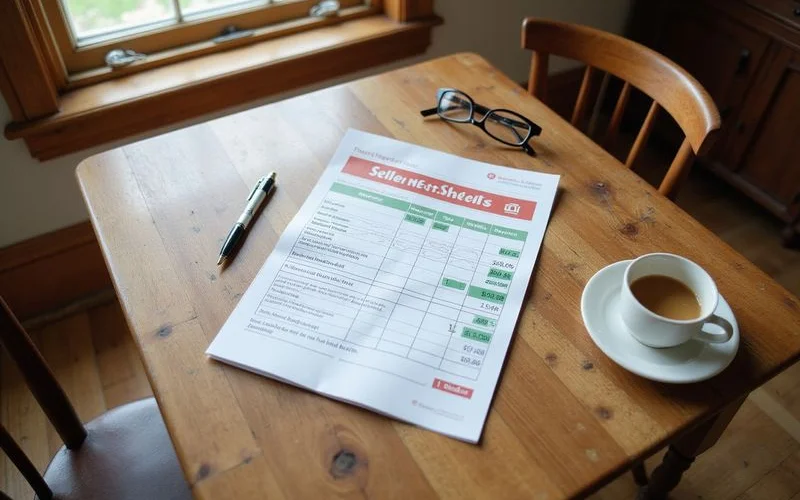
Our team built this sample calculation to show how quickly individual fees add up. This specific example uses a $310,000 sale price and assumes an existing loan balance of $160,000. Property tax prorations are excluded because closing dates dictate those final numbers.
We updated the sewer inspection line to reflect recent 2026 city fee schedule estimates.
| Line item | Example amount |
|---|---|
| Sale price | $310,000 |
| Listing commission (illustrative 5.0%; negotiable) | -$15,500 |
| Duluth sewer inspection certificate (Estimated $115 to $220 in 2026) | -$115 |
| Sewer compliance repairs (none in this example) | $0 |
| Title closing and settlement fees (estimate) | -$850 |
| Minnesota deed tax (0.33%) | -$1,023 |
| Mortgage payoff (illustrative) | -$160,000 |
| Estimated net to seller | $132,512 |
The numbers above represent a typical baseline for a local transaction. A real document will use your exact property details and loan terms. We use this model to prove why knowing your bottom line matters so much.
Why a net sheet matters
Sellers often focus heavily on the top-line sale price. The number that actually funds your next home purchase is the final net. We remind clients that comparing these final payouts is the only mathematically fair way to evaluate a cash offer against a traditional market sale.
How do repairs and concessions affect my net?
Every single repair credit and concession comes straight off your final net proceeds. A $5,000 inspection credit affects your bank account the exact same way as accepting a $5,000 lower purchase price.
We strongly suggest a proactive approach before listing the property on the open market. Addressing known issues early prevents buyers from demanding inflated credits later. Fewer surprises during the inspection period mean a much stronger final payout for you.
We recommend focusing on a few common repair triggers before listing. Early sewer inspections help identify inflow issues immediately. Foundation assessments reveal moisture problems in older fieldstone basements. We also suggest basic roof and window checks to ensure weather barriers remain intact.
How do cash offers compare?
Cash buyers still require you to pay the state deed tax, title costs, and the Duluth sewer inspection. These specific obligations apply even when a company advertises a “no fees” transaction.
We urge sellers to place both options on the exact same net sheet format. Cash offers typically come in significantly lower than open-market values. You can explore the pros and cons in our cash offer vs. listing comparison guide.

When do I see the final numbers?
Our transaction coordinators verify these final numbers on the official settlement statement prepared by the title company. You will receive a Closing Disclosure document detailing every exact charge and credit. Federal guidelines usually require this document to arrive at least three days before your closing date.
We advise clients to review this statement carefully and compare it against their initial estimates. Look for any unexpected processing charges or incorrect property tax prorations. Always ask the escrow officer to clarify anything confusing before you sign the final paperwork.
How can I estimate my own costs?
Our interactive net sheet calculator is the fastest way to estimate your proceeds based on expected prices and payoffs. You can adjust the expected commission rate and loan balances to test different scenarios. Customizing the numbers gives you a realistic target for your next home purchase.
We provide a highly precise version of this document as part of a formal home value report. That report uses real-time neighborhood comps and factors in the likely repairs needed for your specific 1920s or 1930s property. Local compliance fees and county customs change constantly.
We always confirm the current Duluth inspection amounts and title fees directly with local authorities. Check with a qualified tax professional regarding any capital gains questions or specific financial liabilities. Knowing your exact costs is the best way to secure maximum value for your property.
This guide is general information about selling a home in Duluth and Minnesota. It is not legal or tax advice. Rules and fees change, so confirm details with the City of Duluth, your county, your title company, an attorney or a tax professional as needed.